PBIS Expectations Examples: A Schoolwide Behavior Matrix
On this page
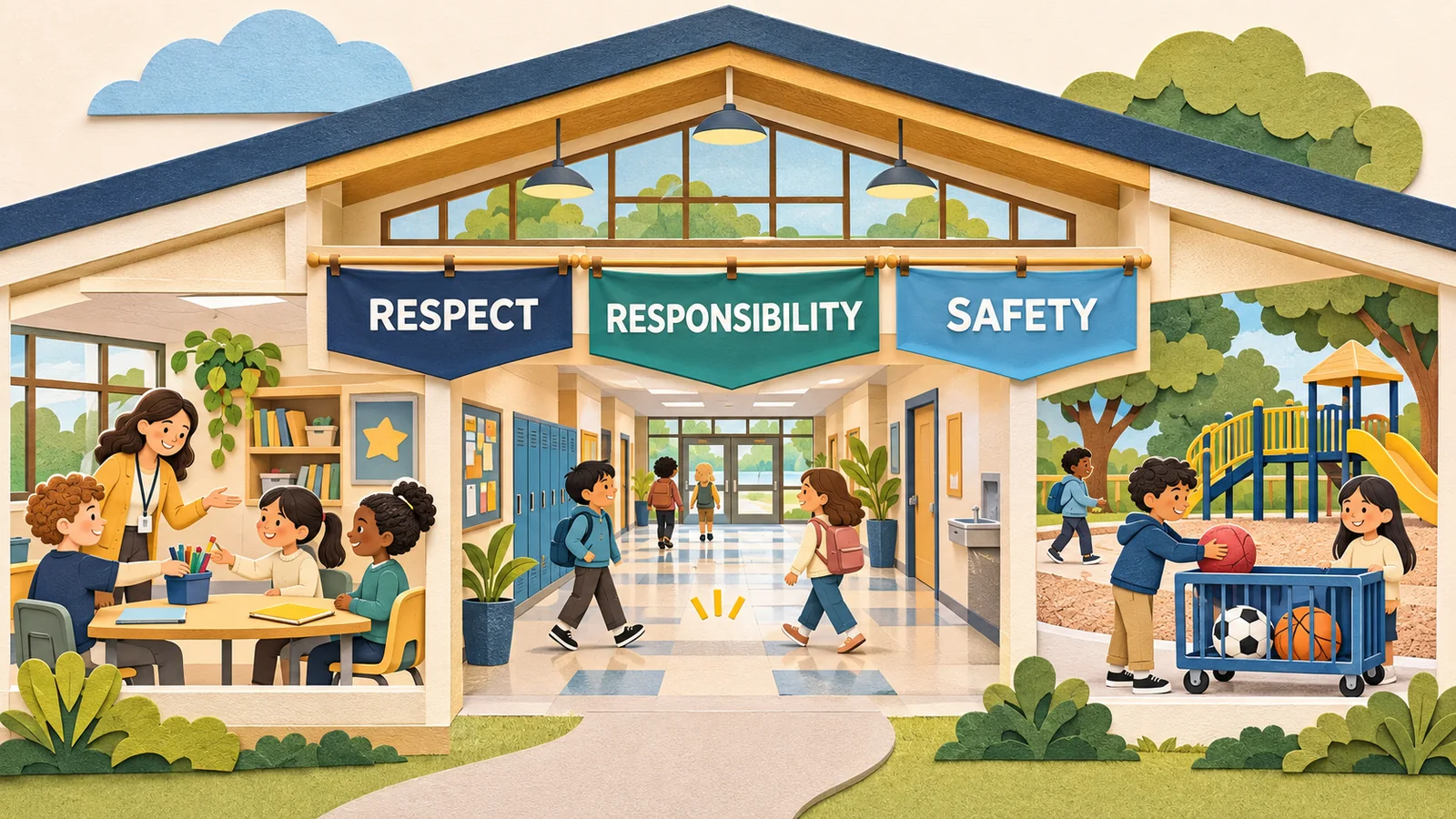
PBIS expectations examples connect a few positive schoolwide expectations—such as Be Respectful, Be Responsible, and Be Safe—to actions students can demonstrate in each setting. A behavior matrix organizes those examples. Staff then teach, model, practice, prompt, and revisit them.
Once your team agrees on that language, custom character education banners can display the short expectations students hear in lessons. Use the banners as reminders of taught behavior, alongside the detailed matrix and routines.
What makes a strong schoolwide expectation?
The Center on PBIS recommends three to five positively stated schoolwide expectations, defined for each routine or setting and explicitly taught. Start with language your school community understands and can use consistently.
Keep these layers connected:
| Layer | Purpose | Example |
|---|---|---|
| Value | Names what the community cares about | Respect |
| Schoolwide expectation | Expresses a broad commitment across settings | Be Respectful |
| Observable example | Shows the commitment in a particular place | Leave space for others to pass in the hallway |
| Routine | Describes the sequence students learn and practice | Put materials away, join the group, and move along the agreed route |
Iowa e-Learning Central distinguishes broad expectations, observable rules, and learned routines. A banner can carry the broad expectation; your lesson explains the actions and sequence.
For broader values-based planning, see our complete guide to character education. If your team is still choosing its shared language, explore our school core values examples and motto ideas.
Schoolwide behavior expectations matrix: a sample to adapt
The table below is Prosign’s original planning example. Use it to build your team’s working matrix, replacing the examples with language that fits your students and campus. It uses three expectations across six settings.
| Setting | Be Respectful | Be Responsible | Be Safe |
|---|---|---|---|
| Classroom | Take turns using the group’s speaking or communication signal. | Put shared materials back in their labeled places. | Keep bags and supplies in the designated storage area. |
| Hallway | Leave space for others to pass. | Bring the materials needed at your destination. | Move at a walking pace along the school’s agreed route. |
| Restroom | Give others space and privacy at stalls and sinks. | Put used paper towels in the bin. | Keep water inside the sink while washing hands. |
| Playground or PE | Invite a classmate to join an open game. | Return equipment to its labeled storage spot. | Keep equipment inside the designated activity area. |
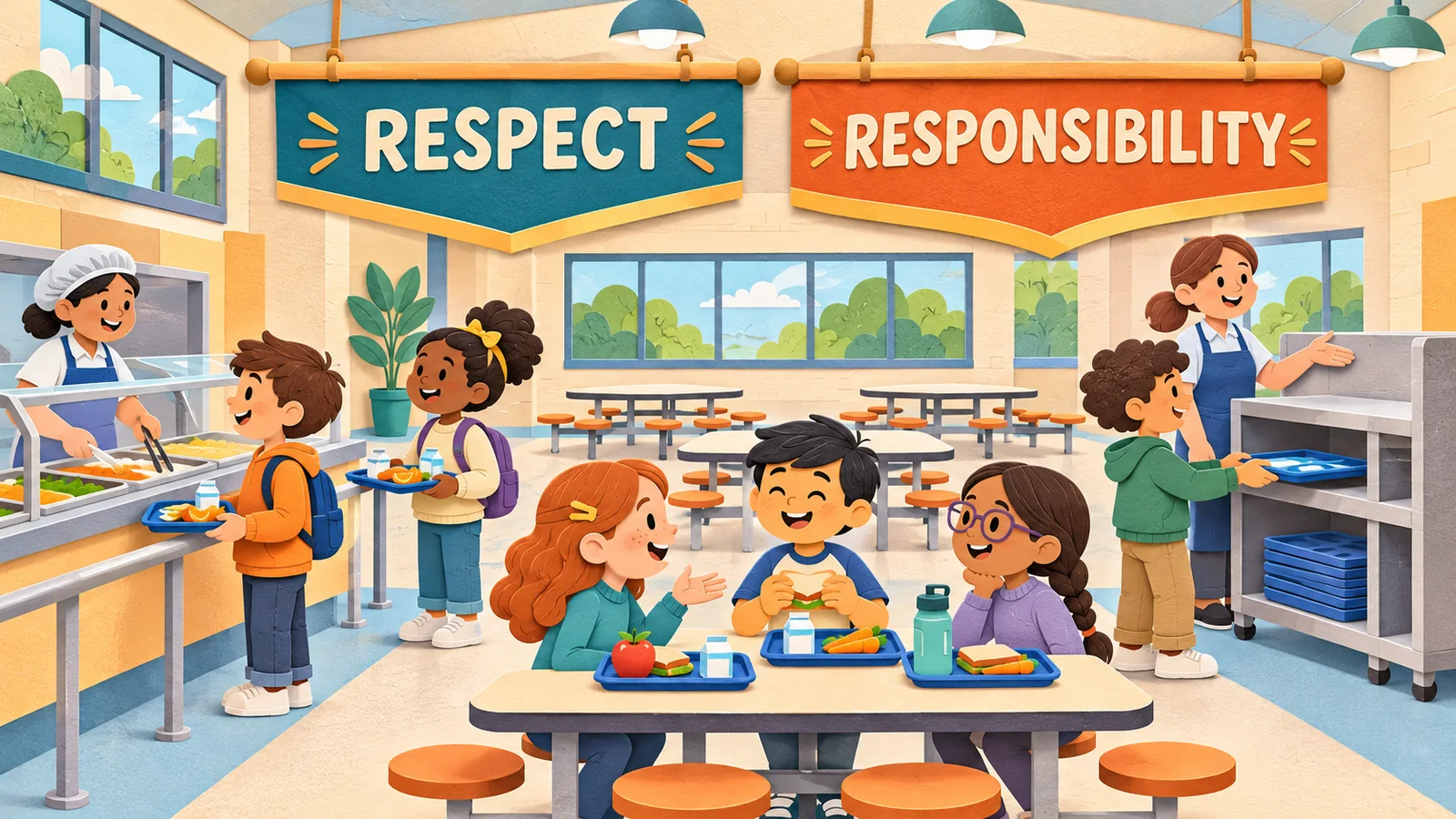
| Cafeteria | Use the conversation volume demonstrated by staff. | Put your tray and litter in the designated places. | Move at a walking pace along the taught route. |
| Arrival and dismissal | Take turns at the designated entry or exit point. | Gather your belongings at the taught cue. | Remain in your assigned waiting area until staff release you. |
For a detailed meal routine, use our cafeteria expectations guide for elementary schools to plan arrival, seating, cleanup, and dismissal lessons.
The Center on PBIS schoolwide teaching-matrix brief connects shared expectations with settings and explicitly taught skills. The finished matrix should guide instruction, including what adults demonstrate and acknowledge.
How do you adapt the matrix to your school?
Ask students, families, teachers, specialists, and staff who supervise common areas to review the examples. Ask, “What would this look like here?” A hallway monitor may identify a transition your classroom team has overlooked.
Check every cell:
- Name an action. Replace “act appropriately” with a behavior someone can see or hear.
- State what to do. Replace “don’t leave a mess” with “return materials to their labeled places.”
- Make the wording teachable. Demonstrate the voice level, route, signal, or storage location the example refers to.
- Allow access. Plan communication, mobility, language, and other supports students need to participate. Avoid making eye contact or one body position the universal proof of respect.
- Keep the priority clear. Choose the most useful examples rather than putting every procedure in every cell.
Carry the same broad expectations into classrooms, with routines suited to each room. The Center on PBIS classroom teaching-matrix brief offers a companion framework for connecting classroom expectations, routines, and skills.
How do you teach PBIS expectations beyond posting them?
Plan a lesson around one setting and one observable action. Iowa’s teaching guidance recommends modeling, guided and independent practice, examples and nonexamples, and repeated instruction. Here is an original hallway lesson your team can adapt.
1. Explain the expectation and its purpose
Point to “Be Respectful” and say: “In this hallway, we leave space for people to pass so everyone can reach their classroom.”
Ask students to describe what enough space looks like in this location.
2. Model the action
Have adults demonstrate moving along the agreed route while leaving passing space. Briefly demonstrate a contrasting example, such as stopping a group across the passage, then show the expected action again.
Keep the demonstration neutral and avoid singling out a student.
3. Practice with support, then check independently
Let students rehearse a short transition with staff coaching. Repeat the transition and observe whether students can demonstrate the action with less prompting.
Ask, “How did we show respect?” Students can explain, point to an example, or demonstrate through their usual communication method.
4. Give specific feedback and prompt the next transition
Connect feedback to the action: “You left space for another group to pass. That showed respect.” Before the next transition, use the same short reminder.
The Center on PBIS schoolwide planning template brings together matrices, setting lessons, prompts, praise, and corrections.
5. Revisit when students need another lesson
Schedule refreshers after breaks, when new students or staff arrive, or when observation shows a routine needs more practice. These are planning suggestions; select the timing for your school.
Missouri Schoolwide PBS resources include initial lessons, booster lessons, and teaching schedules. Use your team’s observations and existing behavior data to choose what to reteach. Check whether adults are using the agreed wording, too.
Which matrix messages work on PBIS signs and banners?
Select the shortest useful message from the language you already teach. Keep the full matrix in staff planning materials and accessible family resources; choose a few words for the banner.
| Matrix connection | Suggested banner wording | Teaching connection |
|---|---|---|
| Respect across settings | Be Respectful | Ask students to demonstrate the setting-specific example. |
| Responsibility across settings | Be Responsible | Name the materials or belongings students manage. |
| Safety across settings | Be Safe | Review the action taught for that location. |
| Shared spaces | Make Room for Others | Practice leaving space during transitions. |
| Classroom or playground responsibility | Care for Shared Materials | Demonstrate returning supplies or equipment. |
These are wording proposals for your team to approve. Prosign’s one-trait-or-phrase character banners let you carry selected language into common spaces with school colors and an optional logo.
Compare banner colors and font choices with the actual words you plan to use. Check the design proof for readability and consistency with the matrix before approving production. Our article on hallway visuals and shared school language offers additional display-planning ideas.
What should the PBIS team approve before ordering?
Use this short handoff checklist:
- The matrix and banner wording use the same expectations.
- Students can explain or demonstrate what each phrase means.
- A staff member owns the lesson and refresher plan for each setting.
- The banner list specifies wording, quantity, colors, font, and any logo.
- The team will review the design proof before production.
Check current character banner options and pricing when preparing the request. Banners are priced individually, and shipping and handling are additional. School purchase orders use Net 30 terms; new customers without a purchase order prepay.
Frequently asked questions
How many PBIS expectations should a school have?
The Center on PBIS recommends three to five positively stated schoolwide expectations. Define specific examples for each setting so broad words have a shared meaning.
Can every classroom have different expectations?
Keep classroom language connected to the schoolwide framework. Teachers can define the routines and examples needed in their rooms while retaining the shared expectations.
How detailed should a PBIS behavior matrix be?
Include a small number of important, observable examples for each expectation and setting. Put step-by-step procedures in teaching plans so the matrix remains usable.
Do PBIS banners replace teaching?
Banners provide a visible cue staff can reference during lessons and daily routines. Students still need instruction, practice, feedback, and support. Displaying a message alone does not establish that students can use the skill.
Turn your agreed expectations into custom banners
Bring your approved matrix language into the spaces where students practice it. Choose one trait or short phrase per banner, gather your school colors and optional logo, and start your custom character education banner order. Review the design proof with your PBIS team so the printed messages match the expectations you teach.
Key Takeaways
- Connect a few positive schoolwide expectations to observable actions in each setting.
- Teach, model, practice, and revisit the behaviors instead of relying on displays alone.
- Use short custom banner messages that match the language in your teaching matrix.