How Hallway Visuals Shape Student Behavior and School Culture (And Why They Matter More Than You Think)
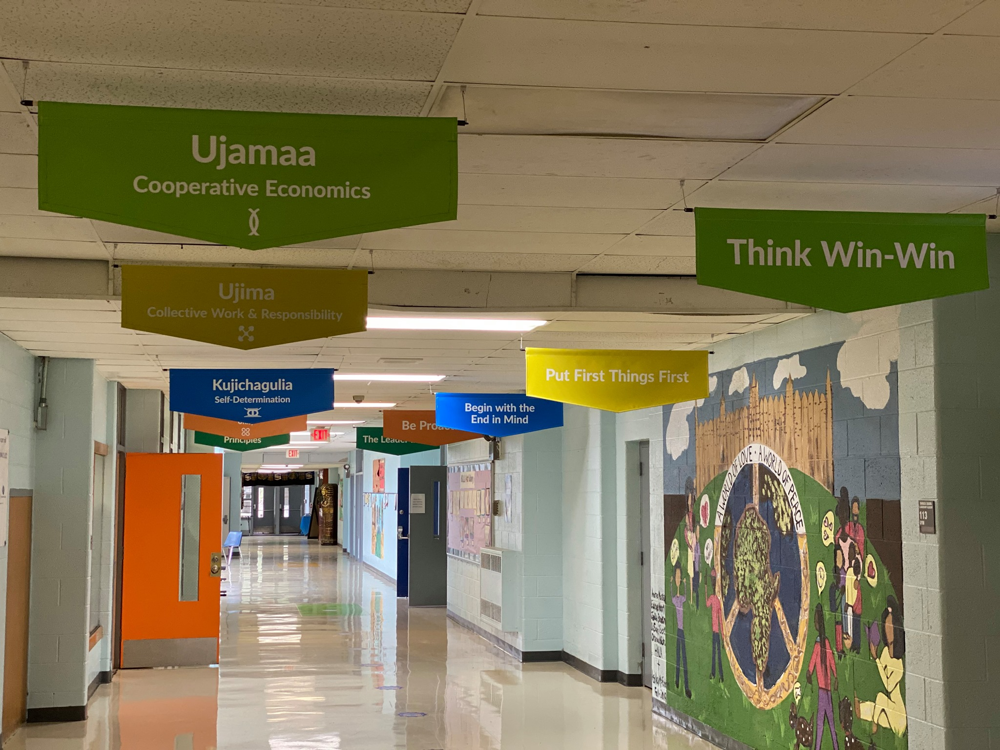
Table of Contents
The Hidden Power of Hallways
School hallways are the most-used but often least-instructed spaces on campus. Hundreds of students traverse these corridors daily, yet hallways typically lack the intentional guidance present in classrooms. It’s easy to view hallways as mere transit zones, but in reality they have a silent influence on student behavior and school norms. One teacher quipped that “the hallway of a school is the busiest place for the longest period of time than anywhere else in the entire building,” observing the myriad behaviors that erupt in just a three-minute passing period 1. From chattering and horseplay to unsupervised mischief, these in-between moments are far from incidental — they reflect and shape your school’s culture.
Administrators who shift their mindset to see hallways as an extension of the learning environment can tap into a hidden power. Research on school design confirms that hallways do more than connect classrooms: “They shape the school’s atmosphere [and] influence behavior” 2. Poorly designed or neglected hallways tend to invite crowding and misbehavior, whereas well-maintained, orderly corridors encourage a sense of calm and order 3. In other words, the physical environment is continually “teaching” students what is normal and expected. The messages on the walls, the images and words students see during every transition, are constantly broadcasting cues about what the school values. In fact, visiting educators often look at a school’s hallway displays as a quick litmus test of its culture — what’s on your walls is a “great clue” to what your community values most 4. If we as leaders don’t take charge of these cues, we miss a critical opportunity. Hallways might be the forgotten classroom, but they are teaching our students every day, whether we plan it or not.
(In short: Hallways are not just walkways; they’re culture-shapers. The rest of this article will explore how to harness that power for positive school climate.)
Why Environment Influences Student Behavior
Why do hallway environments have such an impact on student behavior in schools? Environmental psychology tells us that people absorb norms and expectations from their surroundings, often subconsciously. Children, especially, are highly visual learners — they take in cues from what they see around them and adjust their behavior accordingly. If a school environment is filled with positive reminders and clear expectations, students are more likely to mirror those expectations. Conversely, a chaotic or barren environment sends the message that anything goes.
Evidence from school climate research backs this up. In one study of secondary schools, observers measured aspects of the physical environment — for example, whether hallways had murals and posted behavior expectations or, on the flip side, signs of disorder like litter and graffiti 5. The findings were striking: the physical environment had an indirect but powerful effect. In schools with disorganized, poorly lit hallways and frequent misbehavior, students perceived lower levels of order and felt rules didn’t matter — perceptions linked with higher rates of bullying, fighting, and even weapon carrying 6. In contrast, positive environmental cues (such as student artwork or value-themed displays) helped foster a stronger sense that rules are in place and being followed 6 7. Students’ perceptions of their environment proved critically important to how they acted. Simply put, when hallways look cared-for and full of school spirit and structure, students are more likely to act in line with those norms.
Physical cues also help because they create consistency. A famous principle states that we shape our buildings, and thereafter they shape us. Hallways full of uplifting visuals and clear signposts essentially “train” students in expected behaviors through repetition and familiarity. For example, one facilities expert notes that “reinforcing school values with posters or decals that promote kindness, respect, and responsibility… can shape a more positive atmosphere over time” 8. Meanwhile, something as basic as lighting and sightlines influences conduct — a well-lit, visually open hallway feels supervised and safe, reducing opportunities for mischief 3. It’s no surprise many behavior issues flare up during class transitions or in unsupervised corners; these are exactly the moments when the environment (and lack of it) speaks loudest. One school psychology researcher observed, “Hallways are daunting spaces for teachers”, because without structure students can veer off-task or act out 9. By intentionally designing hallways and other common areas, we address those supervision gaps in a proactive way.
In short, school environment cues student behavior just as much as rules or lessons do. A clean, visually engaging hallway that celebrates positive behavior effectively normalizes that behavior. And critically, improving the physical environment is something administrators can do school-wide — an “institutional change” that can be more feasible (and far-reaching) than trying to correct misbehavior one incident at a time 10.
Character Education Beyond the Classroom
Traditional character education often focuses on scheduled lessons, assemblies, or curricular programs. Those are important, but by themselves they have limitations. The reality is that character isn’t only built in homeroom or health class — it’s lived out in the hallways, cafeteria, and school buses, in all the moments between the lessons. If we want traits like respect and responsibility to truly take root, they must be reinforced constantly throughout the school day, not just discussed occasionally.
Think about it: a student might hear about honesty or kindness in a Monday morning assembly, but by Tuesday afternoon that message can fade if it isn’t continually echoed. As SEL experts note, “Expecting students to remember everything they learn in SEL lessons is not realistic… posting reminders of key strategies makes it more likely that students will bring those strategies into everyday interactions” 11. In other words, visual reminders in schools serve as the bridge between formal character lessons and daily behavior. They keep core values at the forefront of students’ minds exactly when and where those values matter — in real time, as students make choices in the hallways and other unstructured spaces.
Moreover, the frequency of reinforcement matters. Research on effective character education programs shows that the most successful ones integrate character development into every aspect of the school experience, rather than treating it as an occasional add-on 12. This means values and expectations should be visible and palpable everywhere: on walls, in conversations, in routines. A few posters won’t magically transform behavior, of course. But when visual cues consistently align with what’s taught in class, students receive a unified message. Over time, that ubiquity is what shifts norms.
To put it simply, character education can’t just live in the lesson plan binder — it has to live on the walls and in the hallways. The school’s physical environment becomes a constant teacher, subtly nudging students toward the attitudes and actions we want to see. Many principals can attest that after they started weaving positive messaging into hallways and other common areas, the tone of student interactions began to change. Visual reinforcement is especially powerful for younger students or those who need extra cues — a poster saying “Be a Bucket Filler: Help Others” or a sign by the library saying “Quiet Zone — Others are Reading” gives an immediate, concrete reminder of expected behavior. Even for older kids, the environment can provide what one might call “between-the-lines” coaching. It sets the default for what is normal. Without these cues, we leave a lot up to chance (or to the loudest voices in the hallway). With them, we create a school climate where values aren’t just an abstract idea discussed in advisory class, but a living, breathing part of everyday life.
What Effective Hallway Character Displays Actually Do
Hallway displays can range from student artwork and bulletin boards to professionally printed character education banners. But not all displays are equally effective. The best school hallway displays do more than decorate — they actively support positive student behavior in schools. In this section, we break down several key functions that well-designed hallway visuals serve in shaping behavior and culture:
Hallways adorned with character banners and murals at a school. Thoughtful visuals like these serve as constant cues, reinforcing the school’s values in between classes.
Reinforce Shared Language
Effective displays reinforce the shared language of your school’s values and expectations. Most schools have a set of core principles (the classic examples are Respect, Responsibility, Kindness, etc., or perhaps a PBIS acronym or motto). Hallway visuals ensure those words aren’t just spoken at opening assembly and forgotten — they become part of the daily lexicon. For example, a poster series or set of banners might feature each core value with a simple definition or slogan. Every time students pass “Respect — Treat others how you want to be treated” on the wall, it cements that language a bit more.
Repetition is key to mastery. By seeing the same character traits and behavior expectations echoed visually throughout the building, students internalize what those words mean. It also prompts staff to consistently use that vocabulary. Rather than a teacher having to lecture a student for running, a quick point to the “Safe Hallways: Walk and Stay Right” sign is a nonverbal reminder of the agreed rule. As one facilities guide puts it, simple signage like a “Respect Others” or “Be on Time” sign in common areas serves to “remind students of the school’s behavioral expectations” 13. The visuals act like a chorus in the background, always humming the same tune. Over time, this consistency means students from kindergarten through 8th grade all develop a common understanding of what traits like “respect” or “responsibility” look like in action. Shared language is the foundation of a positive school climate — it’s much easier to hold students (and staff) accountable when everyone is speaking the same behavioral “code.”
Support PBIS and SEL Expectations
Visual displays are a natural extension of Positive Behavioral Interventions and Supports (PBIS) and Social-Emotional Learning (SEL) programs. Under PBIS, for instance, schools explicitly teach expected behaviors in various settings (hallways, lunchroom, etc.) and reinforce them constantly. Hallway posters and banners are one of the simplest ways to keep those expectations front and center. They function as prompting cues that remind students what to do without an adult having to say a word. This is especially valuable during transitions, when supervision is stretched thin. A well-placed sign saying “Walk on the right, Voices off” at a hallway bottleneck can preempt misbehavior by prompting self-correction.
Moreover, visuals continue the SEL lessons beyond the classroom. Perhaps students learned about empathy during morning meeting — a bulletin board displaying thought bubbles like “How can I help a classmate today?” in the hallway keeps that lesson alive later in the day. Research shows that such constant reinforcement pays off. In one study, schools that prominently displayed character slogans and expectations saw students retain concepts 25% better compared to schools relying on verbal instruction alone 14. The message here is that visual reminders make learning stick. They also fill the gap “when adults aren’t present” — as one character education guide notes, strategically placed banners provide “24/7 reinforcement of key messages,” helping students make positive choices even in those unsupervised moments 15.
For middle school behavior strategies in particular, where students crave a degree of independence, visuals allow them to self-regulate in a positive way. It’s less authoritarian than constant verbal scolding — the environment itself is guiding them. This aligns perfectly with PBIS philosophy: teach, prompt, reinforce. Hallway visuals do that prompting and reinforcing piece consistently. And when students do meet expectations, those same visuals can acknowledge it (for instance, a poster might say “Thank you for being respectful!” which normalizes that positive feedback). All of this contributes to a more positive school climate, where expectations are clear and upheld consistently through multiple channels.
Reduce Decision Fatigue for Students
Another subtle benefit of having clear visual cues is that they reduce decision fatigue and cognitive load for students. Young people are faced with dozens of micro-decisions during unstructured time: Is it okay to run right now? Can I shout to my friend across the hall? Should I pick up that trash or leave it? Each choice might seem small, but to a child or early adolescent, making the right decision repeatedly can be mentally tiring — especially if they have to consciously recall rules. Hallway visuals ease that burden by externalizing the expectations. The environment itself *“speaks” the rule or value, so the student doesn’t have to dig through memory or willpower each time to behave appropriately.
Think of it like lane lines on a road — drivers don’t have to actively deliberate on where to position their car; the lines guide them. Similarly, a student constantly seeing “Keep Hands and Feet to Yourself” or “Walk on the Right” will, with time, follow those norms almost automatically. This leaves more mental energy for the real goal of school: learning. There’s some evidence backing this up: in schools with abundant character signage, students not only behaved better but also showed improved recall of those character concepts when asked later 14. That improved recall (25% better in one study) suggests the expectations became second-nature, freeing up brainpower.
Additionally, visual cues are persistent and stable, which helps students who might be overwhelmed or distracted. Unlike a teacher’s voice which comes and goes, a poster “doesn’t disappear” — it stays visible until the student processes the message 16 17. For elementary school students (and even middle schoolers) who may not absorb a long verbal lecture, a concise visual reminder is much easier to digest. By simplifying choices (e.g. a student doesn’t have to wonder whether they can use a loud voice in the hall — the sign “Quiet Hallways” has already answered that), we reduce the mental friction. Fewer split-second decisions means fewer chances for a poor choice. In essence, well-placed visuals act like training wheels, keeping students on the right path until positive behaviors become habit.
Normalize Positive Behavior
One of the most powerful things visuals do is normalize and celebrate positive behavior. When value words and positive actions are literally part of the scenery, students begin to see them as the expected norm. Instead of feeling odd or uncool for, say, helping another student, kids start to feel that kindness is “just what we do here.” Hallway displays contribute to this by showcasing positive behaviors and traits as something the school visibly honors.
For example, many schools create bulletin boards recognizing “students of character” or displaying examples of good deeds (like a “Caught Being Kind” board). Banners overhead might proclaim school mottos like “We are Respectful, Responsible, Ready to Learn” — framing these traits as an identity. Over time, these constant cues condition the mindset that positive behavior is standard. As facilities experts note, subtle messaging can accumulate and “shape a more positive atmosphere over time” 8. It’s the same principle as advertising: repeated exposure increases acceptance. In this case, the product is good character, and the “ads” are everywhere.
Another way visuals normalize good behavior is by reducing the attention on negative behavior. If every wall only had “Don’t do X, No Y” signs, the implicit message is that misbehavior is rampant. Far better to frame things in a positive light (“Be Safe, Be Kind”), which assumes students want to do right. It creates a kind of peer pressure in the positive direction—seeing words like Respect, Integrity, Teamwork in big letters makes it clear what qualities are valued in this community. Students often rise to that expectation. In a well-known approach like PBIS, this is crucial: you want to emphasize the positive so that desired behaviors become normative. School-wide visuals reinforce that everyone is on the same team working toward the same ideals. As a result, negative behaviors can start to feel out-of-place. Indeed, schools that saturate their environment with positive cues often report a decline in discipline issues and a calmer mood in the halls 18. When kindness and respect are literally written on the walls, they cease being just aspirational buzzwords and start becoming part of how students see themselves (“our school is a respectful place, so I act respectfully”). In short, visuals help tip the culture to make positive behavior the default expectation.
Strengthen School Identity and Pride
Hallway visuals don’t just regulate behavior — they also build a sense of school identity and pride, which in turn can motivate better behavior. Think about the emotional impact of walking through a school that visibly celebrates its values, history, or student achievements. Murals, banners with the school mascot and motto, flags of student nationalities, or a display of school accomplishments all contribute to students feeling connected to their school. And students who feel proud of their school are more likely to uphold its standards.
Visuals can reinforce the idea that “we are all part of something special here.” For elementary kids, a colorful banner with the school mascot saying “Proud to be a Lincoln Lion — We ROAR with Respect!” can instill a collective pride. For middle schoolers, seeing their own artwork or names on a character trait wall can have a similar effect. One school design expert noted that student-created murals and displays foster a sense of ownership and pride while also reducing negative behaviors like conflict 19. When students literally help decorate the halls, they take personal pride in keeping those halls respectful and clean.
Even professionally made banners can incorporate school identity — for example, by using school colors, logos, or slogans. Consistent branding in signage (like always including the school crest alongside words like “Responsibility” or “Excellence”) makes the campus feel cohesive. According to school signage specialists, the “consistent use of school colors, logos, and themes reinforces a sense of community and pride” on campus 20. Walking down a hallway lined with banners of the school’s core values, each in a different school-color pennant, can feel a bit like walking through the school’s hall of values. It subtly communicates tradition and unity. Students internalize that pride and, importantly, are often motivated to live up to it. For instance, a student might refrain from tossing trash on the floor in a hallway that clearly has been carefully decorated with inspiring messages and school emblems — the environment elicits respect.
In short, hallway visuals contribute to school climate not only by directing behavior, but by boosting morale and a positive identity. They say “this is who we are as a school.” Whether it’s an elementary school character education theme or a middle school motto, displaying it proudly helps everyone (students, staff, visitors) buy into the culture. And when students buy in, they’re more likely to behave in ways that reflect well on that culture.
Elementary vs. Middle School: What Changes
Hallway visuals work for all ages, but the design and approach should be tailored to the developmental level. An elementary school character education initiative will look different from a middle school behavior strategy in its presentation, even if the underlying values are similar. Here’s how the approach changes between younger and older students:
Elementary School Hallway Displays
In elementary schools, students are early in their journey of learning social norms, so visuals often need to be more explicit, frequent, and visually engaging. Younger children respond strongly to bright colors, pictures, and simple wording. Thus, elementary hallway displays tend to be playful and very clear in their messaging. For example, you might see cartoon illustrations next to text like “Use Your Walking Feet” or a friendly mascot demonstrating the expected hallway behavior. These visuals often double as teaching aids — teachers will practice routines like hallway walking and then point to the posters as reminders.
Age-appropriate design is crucial. Early elementary kids (K-2) benefit from images or icons alongside words (e.g., a picture of feet to signify walking, a finger over lips for quiet). The language used is typically positive and simple: “Be kind,” “Take turns,” “Hands to yourself.” Including smiley characters or fun fonts can make the message feel inviting rather than like a scold. Importantly, elementary visuals should be placed at kids’ eye level when possible, so they literally can’t miss them 21. You’ll often find floor decals or lower wall posters in an elementary hallway for this reason.
Another difference: elementary schools often incorporate character education themes monthly, and hallway displays reflect that. One month it might be “Friendship February” with hearts and slogans about friendship on the walls; the next it’s “Responsibility March” with student-made drawings of responsible acts. This rotation keeps young children interested — they look forward to seeing new decorations. And it prevents what some call “wallpaper syndrome,” where kids tune out stagnant visuals (more on that later). Teachers can involve their classes in creating hallway content, too. For example, after a lesson on honesty, a 2nd grade class might make a poster together that gets hung in the hall. This not only reinforces the lesson but gives students a thrill to see their work showcased, further cementing the message.
In short, elementary hallway visuals should be colorful, interactive, and frequent. They essentially extend the classroom onto the walls of the school. Done well, an elementary student can walk down the hall and almost narrate what their community values, because it’s all around them in words and pictures. This constant, visually rich reinforcement is a cornerstone of elementary school character education.
Middle School Hallway Displays
Middle schoolers present a different challenge. They are more independent, peer-conscious, and likely to roll their eyes at anything that feels babyish or overly didactic. However, middle school students still need and benefit from visual reminders — they’re just tuned to a different style. In middle school hallways, the design should be more mature, sleek, and student-driven, while still reinforcing expectations.
A key strategy is to involve students in the messaging so it doesn’t feel like “the adults preaching at us.” For instance, consider using student quotes or artwork in displays about values. A bulletin board might feature anonymous student-written sticky notes answering a prompt like “How I showed respect this week.” Or a banner might be designed by the student council with the school’s motto in graffiti-style art. This gives students ownership. One recommendation is to have student involvement in creating the visuals — it “empowers them, boosts their sense of ownership” of the school’s values 22. A middle school principal might facilitate a contest for the best poster design about anti-bullying, with the winning designs laminated and posted in the halls. When students see that the messaging includes their voices, it gains credibility.
Design-wise, middle school visuals can lean on school pride and aspirational themes. Banners might incorporate the school mascot and a one-word value like “Integrity” or “Determination,” in a bold, sports-team style. The wording can also be more nuanced or inspiring (think quotes from famous figures or student-written pledges) rather than the very literal instructions used in elementary. That said, clarity is still important — a quick slogan or catchphrase works better than a paragraph of text, since middle schoolers rushing to class won’t stop to read fine print. Many middle schools also choose to highlight role models and goals in their hallways: for example, posters of diverse famous people exemplifying the character traits, or a wall of high school or college pennants to subliminally encourage looking ahead.
One must be careful to avoid patronizing older students. Overly cutesy or childish graphics can backfire by disengaging them. Instead, treat the visuals almost like motivational materials you’d see in a high school or even an office: clean design, strong messages, maybe some humor or irony if it fits the school culture. Middle schoolers do have a sense of humor and can appreciate cleverness. A creative hallway display (for example, footprints on the floor that say “Success this way ->” leading to the library) might spark a smile and thus be more memorable. In terms of PBIS, middle schools often use behavior matrices posted around (e.g. a matrix listing hallway, cafeteria, etc., with expected behaviors). These are essentially charts, which older students can handle reading. Making those charts visually appealing (school colors, icons) helps them actually get noticed.
Finally, middle school visuals should account for the fact that students change classes and have multiple teachers — consistency across the building is key. If each teacher posts a different set of rules, it’s confusing; better to have a unified set of expectations posted school-wide so students get the same message no matter where they go. Many middle schools print their core expectations (like the school’s PBIS acronym) on large banners and hang them in every major hallway and the cafeteria, so they become ubiquitous. This consistency creates a stable environment, something adolescents actually crave even as they push boundaries. The bottom line: middle school behavior strategies still heavily rely on environmental cues, but those cues work best when students respect them — which means involving students in their creation and maintaining a tone that is respectful of their growing maturity.
What Administrators Should Look for in Character Banners
If you decide to invest in character education banners or other pre-made visual supports, it’s important to choose products that will genuinely add value (and not just become superficial decor). Here are some practical things administrators should consider when selecting hallway banners or posters designed to promote positive behavior and climate:
-
Durability and Safety: Hallway banners will live in a high-traffic environment, so they must withstand wear and tear. Look for sturdy materials (vinyl is common) that are tear-resistant and fade-resistant, with quality grommets or hanging hardware. Fire safety is also key — banners should ideally be made of flame-retardant material and meet school fire code standards (many vendors provide NFPA 701 certification, for instance). A well-maintained, durable display not only lasts longer but also “communicates a sense of order and pride” in the environment 23 24. In short, invest in banners that will still look good after months or years of hallway exposure, without frayed edges or peeling letters.
-
Clarity of Message: The messaging on the banner should be clear and easy to grasp at a glance. Students bustling through the halls won’t stop to decipher paragraphs. Aim for concise slogans or single-word values with maybe a short tagline. Many experts recommend guidelines like the “3x5 rule” — no more than three lines of text, or five words per line, for quick readability 25. Use large, legible fonts and high-contrast colors (for example, white text on a dark background) so that the text can be read from across the hall 26. Graphics or icons can be helpful, but avoid clutter. An effective banner might simply say “RESPONSIBILITY — Do what’s right, even when no one is watching,” in the school colors with an icon like a torch. That kind of brevity and clarity ensures the banner’s message actually sticks with students.
-
Age-Appropriate Design: As discussed above, the design should fit the age group. Evaluate whether the imagery, language, and overall style of the banners align with your student population. Elementary school character education banners can be more whimsical or feature mascots and bright illustrations. Middle school banners might use sleeker designs, maybe incorporating student art or more sophisticated graphics. Check that any stock images or characters resonate with your students’ demographics and interests. Also consider bilingual text if you serve a multilingual community (e.g., pairing “Respect” with “Respeto” beneath it). The goal is for students to see the banner and feel it’s speaking to them. An age-appropriate banner will engage students rather than induce eye-rolls. Many banner providers offer customization — take advantage of that to use phrases or visuals that your kids will connect with.
-
Alignment with School Values and Programs: The content of the banners should directly reflect your school’s specific values, rules, or character education framework. Generic positive phrases are fine, but it’s even better if there’s a tie-in to language your staff and students already use. For instance, if your school’s motto is “ROAR” (Responsible, Organized, Achieving, Respectful), your banners might feature those four words prominently. This consistency reinforces the programs you have in place. Similarly, make sure the banners support your PBIS expectations or SEL themes — they should be an extension of what’s taught in class or advisory. A disconnect between posted messages and actual school practices will be noticed by students (and could breed cynicism). So, if “kindness” is one of your monthly virtues, a banner about kindness fits perfectly. If you’ve never emphasized “leadership” as a trait, a sudden leadership banner might confuse. Basically, choose visuals that mesh with your existing character education plan and the values your community prioritizes 27. That alignment will make them far more credible and impactful.
-
Placement Strategy: Finally, consider where and how the banners will be displayed, and choose designs/sizes accordingly. Banners should be large enough to be seen in the spaces you intend (hallway ceiling-hung banners often are long and double-sided so they’re visible from either direction). Wall posters should be at eye level for students 21 and placed at key “decision points” — for example, near restroom doors (where you might remind about hand-washing or behavior), at corridor intersections, by the cafeteria line, and certainly at main entrances where students first come in each day 28. You want the most important messages in the places where they matter most. Also, think about sightlines: a banner tucked in a dead-end hallway that students rarely use isn’t doing much work. Hallways that are known hot-spots for misbehavior (perhaps a far wing or a blind spot by the stairwell) are prime real estate for a well-chosen message. Ensure that banners are hung securely (nobody should be able to easily yank them down) and don’t obstruct any safety signage. A good vendor will provide guidance on optimal placement and even hardware. In sum, have a plan so that when the banners arrive, they form a cohesive system throughout the school, not random decoration. Where you place them can be just as important as what they say.
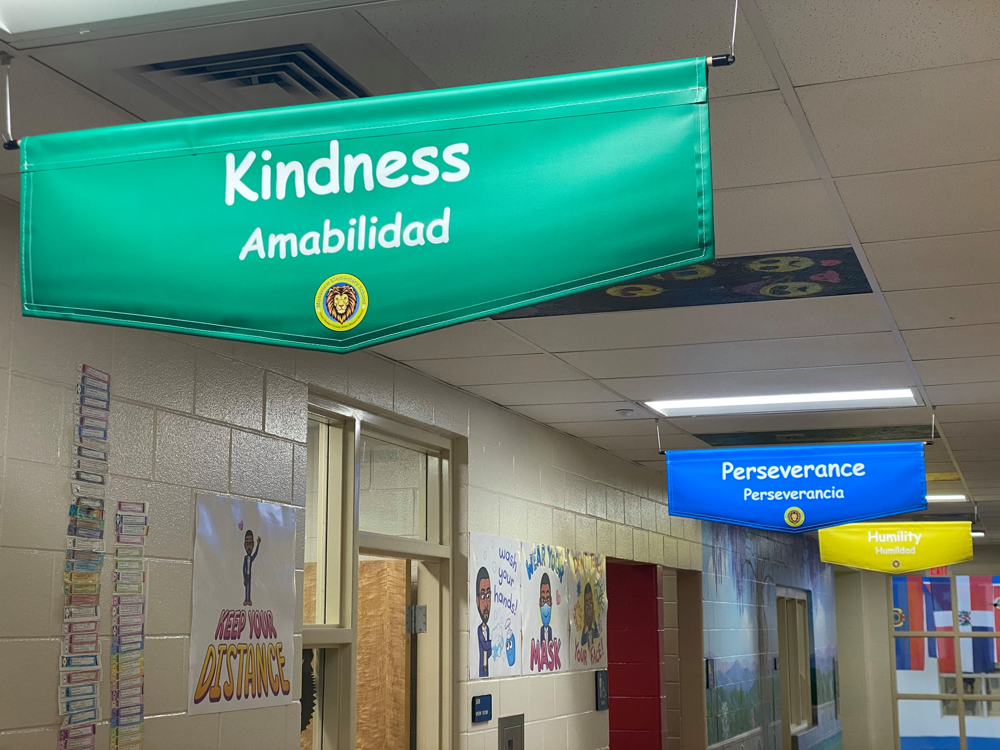
Example of well-designed hallway banners: Clear text with school colors and a bilingual message (“Kindness — Amabilidad”) ensure all students understand the value being promoted. Such banners are durable vinyl, include school logos, and are placed prominently at eye level for maximum visibility.
By mindfully selecting banners that meet these criteria — durable, clear, age-targeted, aligned, and well-placed — administrators can ensure that their visual reinforcement is seen as a credible and integral part of the school environment rather than just wall candy. When done right, these banners become trusted hallway “assistants,” constantly reminding and encouraging everyone toward the school’s cultural goals.
(Note: Many schools choose to work with professional school signage companies to get custom-designed banners that hit all the points above. This can save time and result in a more polished product. For example, you can find vendors that specialize in character education banners and offer customization with your school’s colors, values, and logo.)
Real-World Outcomes Schools Care About
Administrators are rightly results-oriented — it’s fair to ask, What concrete benefits come from investing in hallway visuals and character displays? While every school is different, educators who have prioritized these environmental cues report improvements in several areas that matter:
-
Reduced Behavior Incidents: Perhaps the most immediate impact is fewer disciplinary issues in the hallways and common areas. When expectations are clearly posted and consistently reinforced, students make better choices during transitions. Some schools have documented significant drops in referrals and altercations after installing character signage and implementing related programs. For example, one elementary school that rolled out a comprehensive character initiative (including visual displays in hallways) saw a 40% reduction in office discipline referrals within two years 29. Likewise, broader research compiled by the National School Climate Center found intentional character education initiatives yield on average a 25% reduction in disciplinary referrals and a 30% decrease in bullying incidents 18. Fewer hallway scuffles and office visits mean more instructional time and a safer atmosphere for everyone.
-
Improved School Climate and Survey Results: Hallway visuals are a visible indicator of a positive school climate, and they also help create that climate. Students often report feeling prouder of and more connected to a school that showcases values and celebrates positive behavior. Climate surveys of students and staff may reflect increases in perceived safety, respect, and clarity of expectations. In fact, successful character programs often track improvements in these areas; one guide notes that schools typically see improved ratings on climate measures like safety and respect, alongside the behavior outcomes 30. Parents and visitors walking through halls lined with student art, affirmations, and value statements also get a strong positive impression — which can show up in parent satisfaction surveys and community feedback.
-
Consistency and Buy-In Across Staff: A more subtle outcome is greater consistency in how staff address behavior and reinforce norms. When the school’s core values and rules are literally spelled out on the walls, it provides a common reference point for all adults in the building. Teachers, counselors, and even custodial staff can more easily use the same language (“remember, courage is one of our values — let’s show courage by owning up to the mistake”). This unity reduces mixed messages. As one school behavior specialist observed after establishing clear hallway expectations, “everyone knows what should be happening” and even students begin to expect the same 31. New teachers can quickly get up to speed by noting the posters and banners that highlight the school’s behavior framework, leading to more consistent enforcement from day one. Over time, this consistency strengthens the overall culture — students experience fairness and clarity no matter which teacher or staff member is supervising the hallway.
-
Easier Onboarding of New Students: When a student transfers into your school mid-year, the first exposure they have to school norms is often through the environment. Hallway visuals can function as a silent orientation for new students (and families). They communicate “here’s what we’re about” instantly. For instance, a new 6th grader walking in and seeing banners for “Respect, Responsibility, and Ready to Learn” will know within minutes the key expectations, even before a single conversation with a teacher. This accelerates their integration. Instead of learning the culture through trial and error (and possibly discipline), they have a roadmap from day one. School tours for new families similarly benefit — it’s impressive and reassuring for parents to see core values prominently displayed, and it sparks constructive conversation (“I noticed ‘Be Safe’ signs everywhere — how do you teach safety here?”). In short, a well-curated hallway environment helps newcomers absorb the culture faster. It’s like having an extra orientation guide on the walls.
-
Academic and Attendance Uplift: While the link might not be immediately obvious, a positive, values-rich environment can support academics and attendance indirectly. Students who feel safe, valued, and clear about expectations are more likely to attend school regularly and stay engaged in class. Some schools that improved climate through visuals and other measures later noted upticks in test scores and attendance. This aligns with research finding that comprehensive character education correlates with academic gains (one analysis showed a 5-15% improvement in standardized test scores alongside behavior improvements 30 ). The mechanism is simple: less time spent on discipline and more on learning, plus students who are more self-regulated and cooperative create better learning conditions. While hallway banners alone won’t raise grades, they are one contributing piece in the larger puzzle of school improvement.
Ultimately, these outcomes — fewer incidents, a more positive school climate, unified staff-student expectations, smoother transitions for newcomers, and improved student engagement — are the payoffs that make the investment worthwhile. They illustrate that school culture is built (or broken) in those in-between moments, and by paying attention to something as seemingly small as a poster on a wall, we can influence those moments in a big way.
Practical Implementation Tips
Ready to transform your hallways into a positive force? Here are some practical tips for implementing hallway visuals and character displays effectively, based on what has worked in other schools:
-
Map the Hotspots: Start by identifying where visuals will have the most impact. Prime locations include: major hallway intersections, near the main office (high visibility), by cafeteria and bathroom entrances (where reminders are handy), and any area with frequent issues (e.g. that back stairwell where kids linger). Placing signs at “key decision points” — such as where students choose which way to go or whether to congregate — can gently steer behavior 28. For instance, a friendly “Keep It Moving — See You in Class!” poster at the hallway juncture leading to outside portables might discourage loitering. Eye-level placement is crucial: position posters at roughly 4—5 feet off the ground for middle schoolers (lower for little ones) and try to have them perpendicular to the line of sight so they’re not missed 21. Basically, go where the kids are and make it hard to ignore.
-
Rotate and Refresh Regularly: Overexposure can dull the effect of even the best poster. To avoid students tuning out the displays (the dreaded “wallpaper syndrome”), change them up periodically. Consider aligning refreshes with your school’s calendar. Many schools introduce a new character trait or theme each month and swap out bulletin boards or highlight a different banner accordingly. This keeps content fresh and students curious (“What’s the word of the month going to be in February?”). At minimum, update displays each semester. Some creative approaches include having a “mystery quote” poster that changes weekly, or using digital signage for rotating inspirational messages. Remember, research shows that too many static visuals can become background noise or even distract — one study found young children learned more in a classroom with fewer wall decorations than an overly busy one 32. The lesson for hallways: quality over quantity, and update the visuals often enough that they maintain novelty. A practical tip is to have two sets of posters for certain spots and simply alternate them mid-year.
-
Align with Ongoing Programs: Tie your hallway visuals into whatever character/PBIS/SEL programs you run throughout the year. If September’s focus is anti-bullying, maybe the student council can put up a hallway display of kind messages or pledges. If the PBIS “matrix” is taught in October, ensure the same language on that matrix appears on permanent signs around the school. Many schools leverage seasons and events, too — e.g., gratitude themes around Thanksgiving, perseverance around standardized testing time, etc. By syncing visuals with broader school activities (assemblies, announcements, advisory lessons), you create a multiplier effect. The messages students hear in class are echoed on the walls, and vice versa. This also prevents hallway displays from feeling random or performative; they become an integrated part of the educational process. One practical idea is to create a simple year-long plan (perhaps in summer) that schedules what values or topics will be highlighted each month and prepares the corresponding visuals in advance. That way, you’re always reinforcing what’s already on everyone’s radar.
-
Student Involvement: We touched on this, but it’s worth its own emphasis as an implementation strategy. Involve students in creating and updating hallway displays whenever possible. This could be through an art club painting a mural, a contest for poster designs, or simply featuring student work and ideas on bulletin boards. When students have a hand in it, they take more pride and pay more attention. It’s their hallway, after all. One middle school saw success by having the leadership elective students design a series of value posters in a style that appealed to their peers — these ended up being far more well-received than the generic commercial posters from previous years. For younger kids, even coloring a pre-drawn poster of a character trait can create buy-in (“I helped make that kindness tree in the hall!”). Additionally, rotating student contributions keeps things fresh. Consider a section of hallway or a display case that is a “Character Corner” updated by a different class each month. Beyond buy-in, this strategy boosts the educational value: students reflect on the meaning of the trait as they create something to represent it. And from a climate perspective, it sends a message that student voice is valued in your school’s culture-building. As one facilities article noted, engaging students in design “empowers them and fosters a stronger connection to the environment” 22 — exactly what we want.
-
Avoid Clutter — Be Intentional: It’s exciting to plaster the halls with all the motivational quotes you can find, but be careful not to overwhelm the senses. A cluttered hallway with posters covering every inch can ironically cause students to ignore all of it. Balance is key. Strategically place your most important messages with some blank space around them so they stand out. If you have multiple banners, consider spreading them out by topic (e.g., one value per hallway) instead of all values repeated in one corridor. This gives students a focus in each area. Also, periodically audit your hallway from a student’s perspective: walk the route they walk and see what they actually notice. You might discover that a sign is obscured by an open door, or that there are simply too many flyers on a bulletin board for any single message to pop out. In such cases, pare back. Remove outdated or redundant posters promptly. One research-backed point: extremely busy visual environments can increase cognitive load and distraction 32, which is counterproductive. Our goal is to cue positive behavior, not overstimulate. So embrace a “less is more” philosophy — a few well-placed, well-designed visuals will beat a collage of dozens. Every item on the wall should serve a purpose and align with your core themes. If it doesn’t, reconsider if it needs to be there. By keeping the hallway environment intentionally curated, you ensure that students actually absorb the messages you’ve so thoughtfully put up.
-
Monitor and Maintain: Implementation isn’t one-and-done. Assign responsibility (perhaps to an assistant principal, climate team, or even a student club) for maintaining the displays. This includes everything from keeping them clean and un-torn, to tracking whether students seem to be responding. Encourage staff to reference the visuals in their interactions (“I love how you all followed our ‘One Voice in the Hall’ poster just now — great job!”). When visuals get damaged or old, replace or refresh them to signal that they’re important (a ripped, faded poster sends the wrong message). It’s also wise to gather periodic feedback — maybe ask a few students, “Hey, what do you think of those new banners? Do you notice them?” Their answers can guide future tweaks. Some schools even include a quick walkthrough in their climate meetings to assess the state of the school environment. The bottom line: keep the hallway visuals as a living part of your school culture, not static decorations. Over time, you can evolve them as your school’s needs and themes evolve. Perhaps two years from now you’ll identify a new challenge (say, digital citizenship) and decide to add visuals addressing that. Implementation is an ongoing process of reinforcement, assessment, and adjustment.
Following these tips will help ensure your hallway visuals actually achieve the goal — making your school’s values visible and effective every day — rather than just meeting a decorating quota. It’s about being intentional and responsive, much like any instructional strategy. With some planning and student-centered thinking, your hallways can become one of your strongest allies in fostering the behavior and culture you want.
Conclusion: Culture Is Built in the In-Between Moments
A school’s culture isn’t only formed in formal lessons or assemblies; it’s woven from all the in-between moments — the locker visits, the class changes, the chats by the water fountain. Hallway visuals and displays might seem like small details, but they exert a steady influence in those moments when no teacher is lecturing and no lesson plan is in effect. In a very real sense, they are the silent teachers of our school, constantly modeling and reminding students of who we aspire to be as a community.
By now, the case is clear that attending to hallway environment is not just an aesthetic choice but a strategic one. When you deliberately shape that environment — making it rich with positive cues, aligned with your character education goals, and engaging to students — you are doing something powerful. You’re creating an atmosphere where expectations and values are not abstract, but tangible and visible. Over time, that atmosphere does a lot of heavy lifting: students absorb norms more naturally, behavioral expectations become “the way we do things here,” and the entire school starts to feel more unified and purposeful. It’s the difference between a school where the walls are blank (or filled with random clutter) and the message to kids is “this is just a place you pass through,” versus a school where every corridor exudes a sense of purpose and care.
As a school leader, think of hallway visuals as another tool in your toolkit — one that works continuously, even when you’re not around. Of course, banners and posters alone don’t solve every behavior problem (they work best as part of a larger strategy including good supervision, teaching, and relationships). But used wisely, they truly do shape the narrative of the school day. They keep values like respect, responsibility, and kindness in eyesight and therefore in mind. They remind students that character matters not just when a teacher is watching, but always. And perhaps most importantly, they send the message that the school believes in its students’ ability to rise to these ideals — enough to proudly display them.
In conclusion, hallways are indeed a hidden powerhouse for behavior and culture. By treating those spaces with the same intentionality we give classrooms — through visual reminders, character banners, and a welcoming climate — we create a school where positive behavior is reinforced at every turn. Culture is built in those in-between moments, and we have the ability to guide that construction in a positive direction. So next time you walk your halls, take a look around: what are they saying to your students? With a few thoughtful changes, they could be echoing and amplifying your very best lessons about character and community, every single day.
Soft CTA: Many schools have found success in translating these principles into action by using professionally designed character education banners that reflect their unique values. Such banners, when tailored to a school’s ethos, serve as durable, consistent visual anchors for a positive climate — quietly doing the work of reinforcement and encouragement in those in-between moments. Whether you create your own displays or explore quality banner solutions, the key is to make your hallways speak the language of your school’s best self. Here’s to hallways that teach, inspire, and uplift — even when we’re not looking.
Sources:
-
Sears, M. (2025, August 25). Safe and Functional Hallways and Stairwells in Schools. Fentress Architects Blog — “Hallways…shape the school’s atmosphere, influence behavior” 2 19.
-
Bridgers, G. (2012, Sept 4). The Dreaded Hallway. Always A Lesson blog — anecdotal observation of busy hallway behavior 1.
-
Lindstrom Johnson, S. (2016). ASU News — School environment affects student behavior — study showing physical disorganization leads to perception of less order & more violence 6 7.
-
Elias, M. (2024, Jan 3). Social and Emotional Learning on the Walls. Edutopia — on the importance of posting SEL reminders (“Expecting students to remember… not realistic… posting reminders…” 11; walls as “CAT scan of the soul” 4 ).
-
Skinner, C. (2019). University of Tennessee study (via ScienceDaily) — transitions game reduced disruptions; quote: “Hallways are daunting spaces for teachers” 9.
-
Prosign Design Co. (2023). Complete Guide to Character Education — “Environmental reinforcement through visual design” section 33 14; case study data on referral reduction 29; typical climate and academic improvements 30.
-
Jessup, B. (2023). Using the Right Signage in Schools. Jessup Manufacturing blog — notes that simple rule signs in common areas (“Respect Others,” etc.) remind students of expectations 13.
-
Responsive Classroom (2005). Calm, Friendly Hallway Behavior… — Four Corners School example: clear expectations made hallways calm (“everyone knows what should be happening”) 31.
-
Artcobell Furniture (n.d.). Maximizing Hallway Potential — tip to involve students in hallway design for ownership 22; suggestion to rotate displays to keep them fresh 34.
-
Association for Psychological Science (2014). Decorated Classrooms and Learning — research finding too many visual stimuli can distract students (learning gains smaller in highly decorated settings) 32.
-
SchoolPosterPrinters (2025). Effective School Signage — best practices: place signs at eye level, perpendicular to traffic flow 21 and use concise messaging (3x5 rule) 25.
-
National School Climate Center data (via Prosign guide) — stats: 25% fewer discipline issues, 30% less bullying with character initiatives 18.
-
CESA 6 (2023). How Visual Supports Can Manage Behavior — emphasizes that visual cues “don’t disappear” and can be processed by students at their own pace, unlike verbal cues 16 17.
-
Additional implementation insights drawn from collective educational leadership experience and evidence-based best practices in PBIS/SEL integration (e.g., alignment of messages, avoiding clutter as per Fisher et al., 2014 study on cognitive load).
1 The Dreaded Hallway - Always A Lesson https://alwaysalesson.com/the-dreaded-hallway/ 2 3 8 19 23 24 Safe and Functional Hallways and Stairwells in Schools https://blog.fentress.com/blog/safe-and-functional-hallways-and-stairwells-in-schools 4 11 SEL on the Walls at School | Edutopia https://www.edutopia.org/article/sel-walls-school/ 5 6 7 10 ASU study finds school environment can affect student behavior | ASU News https://news.asu.edu/20161215-solutions-asu-study-finds-school-environment-can-affect-student-behavior 9 School psychologists develop intervention to reduce hallway disruptions | ScienceDaily https://www.sciencedaily.com/releases/2019/07/190722115936.htm 12 14 15 18 29 30 33 Character Education: Complete Implementation Guide for Schools | Prosign Design https://www.prosigndesignco.com/blog/complete-guide-character-education 13 27 The Importance of Using the Right Signage in Schools for Safety and Efficiency https://www.jessupmfg.com/blog/using-the-right-signage-in-schools-enhancing-safety-and-communication.html 16 17 How Visual Supports Can Manage Student Behavior https://www.cesa6.org/blog/how-visual-supports-can-manage-student-behavior 20 21 25 26 28 Effective School Signage: Enhancing Safety, and Communication - School Poster Makers https://schoolposterprinters.com/effective-school-signage-enhancing-safety-and-communication/ 22 34 Solutions: learning hallways https://www.artcobell.com/en-us/blog/classroom-solutions-0 31 Calm, Friendly Hallway Behavior Is Now Part of the School Culture | Responsive Classroom https://www.responsiveclassroom.org/calm-friendly-hallway-behavior-is-now-part-of-the-school-culture/ 32 Heavily Decorated Classrooms Disrupt Attention and Learning In Young Children — Association for Psychological Science — APS https://www.psychologicalscience.org/news/releases/heavily-decorated-classrooms-disrupt-attention-and-learning-in-young-children.html
References
Key Takeaways
Professional hallway signage systems enhance school safety, improve navigation, and create positive learning environments. Investing in quality signage provides long-term value through improved emergency response, reduced confusion, and enhanced school image.


